
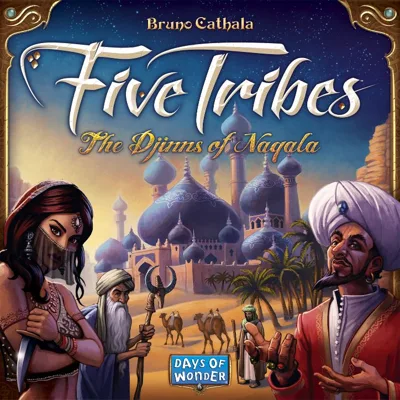
Five Tribes Score Calculator & Score Sheet
Coins, Viziers, Elders, Djinns, tiles, palm trees and palaces, and your merchandise sets — the seven end-game piles from the score pad, totaled for you. Free, for 2 to 4 players.
Score Calculator
| Category | ||
|---|---|---|
| Gold Coins | ||
| Viziers | ||
| Elderscount × 2 pts | ||
| Djinns | ||
| Tiles Controlled | ||
| Palm Trees & Palaces | ||
| Merchandise | ||
| Total | 0 | 0 |
It's a tie at the top — check your rulebook's tiebreaker!
This calculator totals your seven end-game piles and forgets when you leave. Saved games, player stats, and win rates live in the free Meeply app →
Nice game! This page won't remember it.
Refresh and tonight's scores are gone. Meeply keeps every game, every player, every win rate — and gives Five Tribes a category for each of the seven scoring piles so the Vizier majority never gets counted twice.

How Five Tribes Scoring Works
Nothing is scored while you play. You bid for turn order, sweep meeples around the Sultanate mancala-style, and pile up coins, meeples, cards, and camels — then the game ends and seven piles get added together at once. The boxed score pad prints the multipliers next to each line, and they're built into the calculator above. Here's each pile, and where the points hide.
1Gold Coins
Every Gold Coin you hold at the end is worth 1 victory point, so your money is your score — this is the one pile that doesn't need converting. Coins are kept face down during play, which means nobody can size up the leader until the count. Total your coins and enter the number; it usually turns out to be the biggest single line on the pad.
2Viziers
Yellow meeples are worth 1 point each (×1 on the pad), with one enormous exception: the player holding the most Viziers scores 10 points per Vizier instead. Everyone else stays at 1 apiece. Compare the yellow stacks first, decide who has the majority, then multiply — and enter the resulting points here rather than the meeple count, since the rate isn't the same for everybody at the table.
3Elders
Each white meeple in your possession is worth 2 victory points. Enter how many Elders you're holding and the calculator doubles them for you. Elders are also the currency for summoning Djinns, so the ones sitting in front of you at the end are the leftovers — a player who spent theirs well may have a thin row here and a fat Djinn row below.
4Djinns
Each Djinn card you summoned scores the victory points printed on it, and the values differ from Djinn to Djinn. Add up the printed numbers across your cards and enter the total. Worth reading each card again at the end rather than trusting memory — some Djinns also carry an end-game condition in their text, so the printed number isn't always the whole story.
5Tiles Controlled
You control a tile if one of your camels is standing on it. Each controlled tile scores the victory points printed on it, and those printed values vary across the board — the cheap-looking Small Markets and the big Sacred Places are not the same line item. Walk your camels one at a time and total the printed numbers on the tiles beneath them.
6Palm Trees & Palaces
Only the Palm Trees and Palaces sitting on tiles you control count. Each Palm Tree is worth 3 points (×3 on the pad) and each Palace is worth 5 (×5). Because the two rates differ, enter the combined points here — count your palms, multiply by 3, count your palaces, multiply by 5, and add them together. Stacks build up over the game, so check every controlled tile rather than just the ones you remember planting.
7Merchandise
Merchandise cards score as sets of different types, and the table climbs steeply: 1 type is 1 point, 2 types 3, 3 types 7, 4 types 13, 5 types 21, 6 types 30, 7 types 40, 8 types 50, and all 9 types 60. Lay your cards out, pull one of each type into a set and score it from the table, then form another set from what's left and score that too. Enter the combined total. The jump from a 5-type set to a 9-type set is worth 39 points on its own, which is why the market row can quietly decide the game.
The Artisans of Naqala expansion adds artisan meeples and new tiles to the base game, but the seven piles above are still what you total at the end.
Looking for a Five Tribes Score Sheet?
Five Tribes ships with a proper score pad, and if yours has run out — or is still shrink-wrapped in a friend's copy — the calculator above does the same job with the math built in. One row per pile, one column per player, the ×2 on Elders handled for you, totals as you type. It forgets everything when you leave, though. For a score sheet that remembers — every game, every player, every win — Five Tribes is one of 300+ games in the free Meeply app.
More Free Score Calculators
This Page Adds. Meeply Remembers.
A calculator gives you tonight's total and forgets it. Meeply keeps the whole story — every Five Tribes game, every player's win rate, every "I only won because of the Viziers" settled with receipts.
Free to try. Five Tribes is one of 300+ games with rules-aware scoresheets built in.